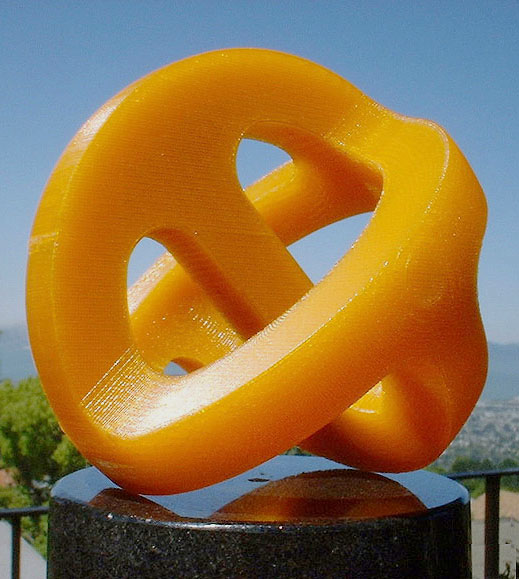
“LEGO®” Knots
Year: 2014 Authors: Carlo H. Sequin; Michelle Galemmo
Core claim
A limited set of rapid-prototyped modular pipe pieces can be dimensioned to assemble a family of knot-like sculptures, loops, and related forms with minimal scaffolding.
Topics
modular sculpture, knot forms, 3D printing, space curves
Domains
geometric modeling, curve sweep geometry, radius scaling, sculpture maquettes, industrial design, toys and modular systems, contemporary art
Methods
CAD modeling, prototype construction, geometric calculation, rapid prototyping
Media
3D-printed plastic, LEGO® DUPLO parts, square cross-section pipe segments
Paper text
The text below is the locally extracted OCR/Markdown version of the paper. Raw PDF files remain local and are not published here.
Proceedings of Bridges 2014: Mathematics, Music, Art, Architecture, Culture
”LEGO®” Knots
Carlo H. Sequin and Michelle Galemmo EECS Computer Sciences, University of California, Berkeley E-mail: sequin@cs.berkeley.edu
Abstract
We present the design and prototype construction of a small set of snap-together parts that permit constructing sculpture maquettes in the form of prismatic extrusions along certain modular space curves. This allows the formation of open-ended structures such as “Interaction2” by Henk van Putten and the “Coriolis” series by Bruce Beasley, or closed-loop sweeps like van Putten’s “Borsalino” or Paul Bloch’s “Symmetrical Enigma” and simple knot shapes. The parts are designed so that they can be readily fabricated on inexpensive rapid-prototyping machines and so that they mesh with the LEGO® DUPLO parts.
1. Introduction
This work was inspired by two pieces of art work by Henk van Putten [12] (Fig.1a,b) exhibited in the art exhibit of Bridges 2013 in Enschede, Netherlands. The geometry of these pieces is explained in [11] and some additional sculptures based on the same modular elements are shown there (Fig.1c,d).
 (a)
(a)
 (b)
(b)
 (c)
Figure 1: Sculptures by Henk van Putten: (a) Interaction 2, (b) Borsalino, (c) edge-frame version of Borsalino, (d) Contrapunctus No 14.
(c)
Figure 1: Sculptures by Henk van Putten: (a) Interaction 2, (b) Borsalino, (c) edge-frame version of Borsalino, (d) Contrapunctus No 14.
 (d)
(d)
On Henk van Putten’s Facebook homepage [12] more sculptures can be found that are mostly composed of a few of the same geometrical elements. We thought it would be fun to experiment with these elements in a tangible manner in real time. Thus we set out to design and prototype a set of modular pipe pieces that snap-together in a “LEGO®-style” manner, and which can readily be reconfigured into many of the shapes introduced by Henk van Putten, or into other shapes inspired by Paul Bloch [5] or Bruce Beasley [3]. We gave ourselves the additional goal to design these parts in such a manner that they could be built readily on inexpensive rapid prototyping machines such as the Afinia_H479 3D Printers [1], which dispense only a single plastic material. We aimed at minimizing material costs and build times, as well as any subsequent clean-up needed. This implied designing geometries that in at least one build orientation require only a minimal amount of support scaffolding, which can then easily be removed.
2. Basic Borsalino Geometry
We started out designing the two parts needed for the construction of the Borsalino shape (Fig.1b) as explained by Henk van Putten [11]. All parts are basically sweeps of a square cross section along sweep curves that form circular arcs. The Borsalino needs two building blocks (Fig.2a): the three (orange) end-
Séquin and Galemmo
caps that form tight turns, and the six (green and cyan) connector pieces, which exhibit gentler bends through an angle of . To form the tight, smoothly connected Borsalino configuration, the sweep radius of the end-cap (“E0.5s”) has to be half the side, , of the square cross section, and the radius of the medial axis of the connector (“C1.207s”) has to be times larger. This follows from solving the quadratic equation derived from Figure 2b, which is the enlarged upper right corner of Figure 2a:
 (a)
(a)
 (b)
Figure 2: Borsalino geometry: (a) CAD model of Borsalino; (b) calculating the connector radius; (c) Borsalino assembled from nine plastic pieces.
(b)
Figure 2: Borsalino geometry: (a) CAD model of Borsalino; (b) calculating the connector radius; (c) Borsalino assembled from nine plastic pieces.
 (c)
(c)
For our first round of implementation we elected to build all parts as hollow pipe segments with a square cross section. The nominal sleeve dimension by which consecutive pipe modules fit together was chosen to be one inch, the initial wall-thickness was 70 mils (thus ), and the sleeve insertion depth was 0.2 inches. (For an alternative, preferred, dimensional choice, see Section 9). To keep the surface of the end-caps free from any scaffolding remnants, we want to build it with the openings pointing downwards. In order to avoid depositing any scaffolding along the sleeve at the male end, the transition from the nominal sleeve profile to the outer wall was tapered at (Fig.3b). Later it transpired that the connector parts can be built without any scaffolding, if the female end points downward (Fig.3a); all end flanges can then be kept square and planar. We can also obtain square end flanges in the end-caps, if we build them with two female ends (Fig.3c), and also build separate insertable sleeves (Fig.3d) that can turn one or both ends into male connectors. On the inside of the end-caps a gabled roof is formed, slanted at , so that it can also be fabricated without the use of any scaffolding.
 (a)
(a)
 (b)
(b)
 (c)
Figure 3: Fabrication issues: (a) standard C1.376 part with built-in sleeve, (b) E0.57 with tapered male flanges, (c) enlarged E0.914 with two squarely cut female ends and with (d) separate, insertable sleeve. (The small numbers indicate the sweep curve radius in inches.)
(c)
Figure 3: Fabrication issues: (a) standard C1.376 part with built-in sleeve, (b) E0.57 with tapered male flanges, (c) enlarged E0.914 with two squarely cut female ends and with (d) separate, insertable sleeve. (The small numbers indicate the sweep curve radius in inches.)
 (d)
(d)
3. Loose Borsalino Loops
Eight connector pieces can readily form a circular loop. With a half-circle made from four C1.376 pieces in hand (Fig.4a), one then may wonder what it would take to connect three such half-circles into a
“LEGO®” Knots
Borsalino loop. Calculating the necessary radius of the larger C3.322 pieces follows the same rules as above: We need to expand the turning radius of the half-circle by a factor of . Thus the sweep curve of the original Borsalino shape is simply scaled up uniformly by a factor of . However, a simulation of this construction (Fig.4b) showed it to be too “loose” aesthetically. Instead we just created an intermediate-size E0.914 element with a radius of , and by stretching this radius by a factor we created the corresponding larger C2.207 connectors. The result is shown in Figure 4c.
 (a)
(a)
 (b)
Figure 4: A looser form of the Borsalino: (a) half-circle built from four C1.376; (b) modeling a looser Borsalino loop based on this half-circle; (c) sculptural assembly based on the larger E0.914 (Fig.3c).
(b)
Figure 4: A looser form of the Borsalino: (a) half-circle built from four C1.376; (b) modeling a looser Borsalino loop based on this half-circle; (c) sculptural assembly based on the larger E0.914 (Fig.3c).
 (c)
(c)
In addition, we also cut this enlarged E0.914 end-cap into four equal pieces: “C0.914”. With this assortment of two types of end-caps (Fig.3b,c) and three different connectors, we can now try to create some new assemblies as shown in Figure 5. However, these “2-lobe cross-over Borsalino loops” close up only approximately, leaving some narrow wedge-shaped gaps between pieces. Checking the math (Fig.5d) shows that regardless of the relative dimension of the square cross section, it is always required that . Thus Figure 5a, which uses the tight E0.57 and the newly cut C0.914, would require a C0.973 connector; thus the radius of C0.914 is too small. In Figures 5b,c we used the larger E0.914 and the standard C1.376 connectors; however, these are smaller than the required connectors of size C1.619. And when we use end-caps made from four standard C1.376 pieces (Fig.4a), the larger C2.207 connectors are also smaller than the needed (Fig.5e).
 (a)
Figure 5: 2-lobe cross-over Borsalinos: (a) an assembly using Borsalino components and ; (b,c) using the larger components and ; (d) design constraints for these constructions; (e) a version using the half-circle from Figure 4a and ; (f) a version with twisted connectors.
(a)
Figure 5: 2-lobe cross-over Borsalinos: (a) an assembly using Borsalino components and ; (b,c) using the larger components and ; (d) design constraints for these constructions; (e) a version using the half-circle from Figure 4a and ; (f) a version with twisted connectors.
 (b)
(b)
 (c)
(c)
 (d)
(d)
 (e)
(e)
 (f)
(f)
4. Rhombic Borsalinos
Playing with the various pieces, it occurred to us that stretching the connection in the middle of each C1.376 pair in the regular, tight Borsalino loop would lead to another interesting configuration. The two square end cross sections, which normally connect into a single end-cap, shift past one another, until they are located corner to corner (Fig.6a) when the inserted link is of length . Now we can close off these
Séquin and Galemmo
two ends with a new piece, called “ ”, which sweeps the square cross section through a half-circle around one vertex, parallel to one of its face diagonals. This is the same as sweeping a “rhombic” cross section, i.e., a square with an azimuthal rotation of , along an arc with a radius enlarged by . Figure 6b shows the result.
 (a)
(a)
 (b)
Figure 6: Rhombic Borsalinos: (a) an extension between pairs of connectors leads to a flipped-over, rhombic Borsalino loop (b); (c) diagonal bending of connectors leads to a rhombic Borsalino (d).
(b)
Figure 6: Rhombic Borsalinos: (a) an extension between pairs of connectors leads to a flipped-over, rhombic Borsalino loop (b); (c) diagonal bending of connectors leads to a rhombic Borsalino (d).
 (c)
(c)
 (d)
(d)
Now that we have this new ER0.806 piece, we may trace out the whole Borsalino shape with a consistent rhombic sweep along a composite sweep curve that has been scaled up by . This requires six new rhombic connector pieces, of size “CR1.946” (Fig.6c). Figure 6d shows the complete rhombic Borsalino.
5. Adding Twisted and Helical Pieces
Even though Figures 6b and 6d have a somewhat twisted look, these generalized cylinders are still minimum-torsion sweeps. However, the rhombic Borsalino (Fig.6d) is loose enough, so that there is room to add actual twist into the six connecting pieces (“CRT1.946”). To keep the ER0.806 end-caps in the same position, we must give each connector pair a total twist of . This leads to two new parts: “CTR1.946” and “CRT1.946” because of the asymmetry introduced by the male and female coupling sleeves (Fig.7a,b). With such a pair we can form twisted connections between consecutive ER0.806 end-caps. Figure 7c has a single such twisted link at the bottom; Figure 7d has all three links twisted.
 (a)
Figure 7: Twisted rhombic Borsalinos: (a,b) twisted connector pieces CTR1.946 and CRT1.946; (c) loop with ONE twisted connector segment; (d) loop with THREE twisted connectors.
(a)
Figure 7: Twisted rhombic Borsalinos: (a,b) twisted connector pieces CTR1.946 and CRT1.946; (c) loop with ONE twisted connector segment; (d) loop with THREE twisted connectors.
 (b)
(b)
 (c)
(c)
 (d)
(d)
Modeling these twisted connectors offers some challenges. The outside surface should be nice and continuous when these parts are chained together; thus it wants to be part of a continuously twisting helical structure. On the inside, however, we want to have short straight sleeve sections at both ends, so that these parts can fit together with any of the other -Knot parts. We found that a good way to model the inner surface is with a sweep along a cubic B-spline, where the end-points and end-tangents are carefully adjusted to match up seamlessly against the straight sleeve sections. Thus most of the fabricated parts have somewhat non-uniform wall thicknesses.
“LEGO®” Knots
With these additional pieces we can make many new intriguing and/or aesthetically pleasing shapes. For instance, four of these twisted connector pairs readily form a ring with a continuous twist of (Fig.8a). Alternatively, three such pairs combined with three pairs of un-twisted connectors, can form an undulating ring, similar to what is known to chemists as the chair configuration of cyclohexane; this toroid has a total twist of only and thus the properties of a Möbius prism ring (Fig.8b). These twisted connectors can also be used in the 2-lobe cross-over Borsalino (Fig.5f). But even the rhombic end-caps by themselves can form intriguing shapes (Fig.8c,d).
 (a)
(a)
 (b)
(b)
 (c)
Figure 8: Combining rhombic pieces: (a) twisted loop made from eight twisted connector pieces; (b) “chair” configuration made from 12 pieces; (c) four rhombic end-caps; (d) six rhombic end-caps.
(c)
Figure 8: Combining rhombic pieces: (a) twisted loop made from eight twisted connector pieces; (b) “chair” configuration made from 12 pieces; (c) four rhombic end-caps; (d) six rhombic end-caps.
 (d)
(d)
Looking at Paul Bloch’s inspiring sculptures [5] we notice that several of them have some helical sections. Thus a helical component seems like a useful building block. We decided to make this component of helical turn (Fig.9a,b) and to set the pitch of the helix so that two identical helices could be tightly intertwined (Fig.9c). So far we have focused on just realizing left-handed spirals (Fig.9d).
 (a)
(a)
 (b)
(b)
 (c)
Figure 9: Helices: (a) one helical piece; (b) two turns of a spiral formed with 16 pieces; (c) interdigitated spiral sweeps; (d) serially connected spiral loops.
(c)
Figure 9: Helices: (a) one helical piece; (b) two turns of a spiral formed with 16 pieces; (c) interdigitated spiral sweeps; (d) serially connected spiral loops.
 (d)
(d)
6. Playing with the Parts
Figure 10 shows some more sculptures by van Putten that we may be able to emulate with LEGO® Knots.
 (a)
(a)
 (b)
(b)
 (c)
Figure 10: Inspirational sculptures by Henk van Putten: (a-d) found on his Facebook timeline [12].
(c)
Figure 10: Inspirational sculptures by Henk van Putten: (a-d) found on his Facebook timeline [12].
 (d)
(d)
Séquin and Galemmo
With the modular parts available, we try to construct shapes that capture the essence of the above sculptures. Figure 11 shows mostly successful emulations, with the exception of Figure 10d, for which we lack the half circles with the proper matching radii.
 (a)
(a)
 (b)
(b)
 (c)
Figure 11: Emulation of van Putten’s sculptures with -Knot pieces: (a) of Fig.1a; (b) of Fig.10a; (c) of Fig.10b; (d) of Fig.10c.
(c)
Figure 11: Emulation of van Putten’s sculptures with -Knot pieces: (a) of Fig.1a; (b) of Fig.10a; (c) of Fig.10b; (d) of Fig.10c.
 (d)
(d)
Next we let ourselves be inspired by work of Paul Bloch [5], and create some shapes that use similar elements to those found in his sculptures. Because of the modularity of our parts, our helices need to be regular (Fig.12b) and cannot reproduce the continuously changing curvatures found in Bloch’s work (Fig.12a). The end-cap pieces can form intriguing compact closed loops (Fig.12c) as well as 2D or 3D Hilbert curves; Figure 12d shows a quarter of a complete 3D Hilbert curve of the generation.
 (a)
(a)
 (b)
(b)
 (c)
(c)
 (d)
(d)
 Figure 12: (a) “After Wright” by Bloch [5]; (b) an emulation thereof; (c) another closed loop; (d) a part of a 3D Hilbert curve.
(a)
Figure 13: (a) Sculpture by Beasley [4] inspiring free-standing -Knot assemblies: (b), (c), (d,e).
Figure 12: (a) “After Wright” by Bloch [5]; (b) an emulation thereof; (c) another closed loop; (d) a part of a 3D Hilbert curve.
(a)
Figure 13: (a) Sculpture by Beasley [4] inspiring free-standing -Knot assemblies: (b), (c), (d,e).
 (b)
(b)
 (c)
(c)
 (d)
(d)
 (e)
(e)
In October 2013 Bruce Beasley opened Coriolis [4], a 3D-Printed Art Exhibition at the Autodesk Gallery in San Francisco. All exhibited sculptures were basically sweeps of a square cross section along one or more intricate free-form space curves. While it is not possible to model the continuously varying
“LEGO®” Knots
curvature exhibited in most of these sculptures with our modular -Knot parts, we can still let ourselves be inspired. Figure 13a shows a vertically thrusting sculpture by Beasley and a couple of -Knot constructions inspired by it. For this kind of sculpture, we made a special platform that holds the lowest part upright.
Also in down-town San Francisco, one can admire three sculptures by Jon Krawczyk [6]; these are also progressive sweeps with a square profile (Fig.14a). Since they touch the ground with two legs, we fabricated a second platform and started to construct our own free-flowing sweeps (Fig13b,c).
 (a)
(a)
 (b)
(b)
 (c)
Figure 14: (a) Sculpture by Krawczyk [6] inspiring free-standing -Knot constructions .
(c)
Figure 14: (a) Sculpture by Krawczyk [6] inspiring free-standing -Knot constructions .
7. Non-Trivial Knots
All of the shapes presented so far have been open-ended sweeps or simple loops equivalent to the unknot or to a simple torus. Now we would like to form some non-trivial knots using the pieces introduced so far, but also making the resulting knot sculptures look nice and elegant. To make this possible, we give ourselves the freedom to introduce one new piece each for every new type of knot sculpture.
Let’s start with the trefoil knot (Knot ). Six helical pieces form of a helical spiral loop, which forms a key element of a nice, tightly wound trefoil knot. We place three such loops into a -symmetric configuration [8] and adjust the rotation around the three axes (passing between the lime and green colored pieces), as well as their distances from the origin, with the goal to line up the three pairs of ends of the helical arcs as best possible. We then introduce one new connector piece, shown in magenta, to close the trefoil loop (Fig.15a). Figure 15b shows the physical realization of the LEGO® Trefoil-Knot.
 (a)
Figure 15: Non-trivial knots: Trefoil knot (Knot ); Figure-8 knot (Knot ).
(a)
Figure 15: Non-trivial knots: Trefoil knot (Knot ); Figure-8 knot (Knot ).
 (b)
(b)
 (c)
(c)
 (d)
(d)
Next we tackle the Figure-8 knot (Knot ). The most symmetrical configuration of this knot has symmetry [8], with a vertical axis and glide symmetry around the equator (Fig.15c). Because this knot
is non-chiral, i.e. is its own mirror image, we cannot use the helical loops used in the trefoil knot (so far we have made only left-handed helices!). Thus we use planar, hemi-circular loops made of four blue or cyan C1.376 components each. To bend the ends of these arcs more closely into the direction in which they need to join up with a corresponding end, we can use a rhombic CR1.376 piece at one end. We could also use our straight piece from Section 4 (Fig.6a) to shorten the remaining gap. Again a new custom piece with the appropriate amount of bending and twisting is needed to complete the closure. But now we need two pairs of mirror images because of the amphichiral nature of this knot. It also turned out that there was an un-appealing discontinuity in curvature at the junction between the straight piece and the new connector piece; so we decided to combine these two elements into a single new custom piece (and its mirror image) with a more gradual change in curvature and twist; they are shown in magenta and red in Figure 15c. This then leads to a rather smoothly curved knot construction (Fig.15d).
8. Lessons Learned
The decision of constructing hollow-wall pipe segments with open ends was definitely a good choice. Originally we contemplated adopting the LEGO^{®} system with several protruding nibs to form the connections between pipe segments. But this offers no advantage and would use more material and more complex scaffolding structures. The open-connection pipe construction also allows us to insert a chain of Christmas lights and make some glow-in-the-dark sculptures (Fig.17c). For sculptures that do not form closed loops, we have fabricated special, minimal, flat, square caps to close off any truncated pipe sweep.
The hardest question has been: How many different turn radii should be provided, and what should be their respective radii. It is clear that we want to start with a tight end-cap that leaves no hole when two such parts are joined into a circular disk. This E0.5s then mandates C1.207s parts to construct a tight Borsalino. Four of these pieces can then form another much looser end-cap, which would require correspondingly looser C2.914*s connectors. An end-cap with an intermediate turning radius is clearly desirable. We already had the C0.914, which was actually our first part built, based on a yet incomplete understanding of the Borsalino geometry and its constraints. With hind-sight we might make a more logical choice: e.g. R=0.973, where the C0.973 parts then enable us to construct a perfect, tight, 2-lobe cross-over Borsalino (Fig.5a).
Finally, as far as dimensioning goes, any special nominal values should be applied to the visible outer diameter of the pipe cross-section rather than to the dimensions of the connecting sleeve. The wall thicknesses could then vary in the inward direction without affecting the external look of the assembly. A plausible choice would be to choose an outer dimension of 32mm corresponding to the LEGO^{®} DUPLO block dimensions [7].
9. LEGO^{®}-DUPLO
By pure serendipity, our sleeve dimensions of 1 square inch just fit around 4 nibs of the LEGO^{®} DUPLO system. But with our chosen wall thickness of 0.07″ we do not get a smooth outer match to those parts. LEGO^{®} DUPLO Knot parts are based on a 32mm module. The actual LEGO^{®} DUPLO parts are slightly smaller, so that two parts can easily fit next to one another onto a larger DUPLO piece. Thus our outer profile dimensions should be: 31.6mm = 1.2441 inches. To match well with the DUPLO parts, the connecting sleeves should form 1-inch squares ( = 25.4mm) to fit around the DUPLO studs, as well as fitting inside the bottom part of a LEGO^{®} DUPLO brick. A thickened rim at the female end can yield the needed 1″-square connection around the 4 nibs. The DUPLO stud height of 5mm determines the length of the sleeves to be 0.1969 inches. Such parts will nicely mesh with the DUPLO parts (Fig.16).
As far as bending radii are concerned, a good choice is to have a C32 part (we now indicate the bending radii in mm, rather than in inches); this gives us a nice arch on top of the LEGO^{®} DUPLO
“LEGO®” Knots
“bridge” piece (Fig.16c). This in turn allows us to make a nice Borromean tangle (Fig.17a). For the rhombic pieces we need a radius that is larger, i.e., CR45.25. Figure 17b shows another link in which we have combined standard straight LEGO® DUPLO blocks and our own new curved components.
 (a)
(a)
 (b) (c)
 (d)
(d)
 Figure 16: (a) DUPLO pieces and C24 connectors; (b-d) resulting assemblies.
(a)
Figure 16: (a) DUPLO pieces and C24 connectors; (b-d) resulting assemblies.
(a)
 (b)
Figure 17: Linkages with DUPLO pieces: (a) Borromean rings ; (b) Hopf link ; (c) glow-in-the-dark sculpture illuminated by internal Christmal lights.
(b)
Figure 17: Linkages with DUPLO pieces: (a) Borromean rings ; (b) Hopf link ; (c) glow-in-the-dark sculpture illuminated by internal Christmal lights.
 (c)
(c)
When making ABS prototype parts on a FDM machine, a wall thickness of 80mils inches) is recommended. For bent or twisted pieces, the walls may vary in thickness to maintain a geometry, where most over-hanging surface elements are steeper than 45 degrees, so that these areas can be built by cantilevering subsequent ABS beads without the need for any supporting scaffolding.
10. Discussion and Future Work
Compared with earlier work on Tubular Sculptures [10], which was a formula-based way of constructing many sculptures belonging to a single family, LEGO®-Knots yields an experimental hands-on approach. A limited set of part types, all based on the sweep of a unit-square cross-section, allow the user to construct a wide variety of sculptural forms. The question now arises: When is that set rich and extensive enough? What would it take to readily make more complicated knots or to emulate more closely other sculptures by Paul Bloch [5] or Bruce Beasley [3]? It obviously would be nice to also have helical pieces
Séquin and Galemmo
that make right-handed helices, and also straight, as well as curved pieces with right-handed and left-handed twists. But what about pieces that allow branching, such as Y-shaped or T-shaped 3-way junctions and/or X-shaped 4-way junction pieces? Perhaps we would then be able to construct a shape like Homage to Max Bill (Fig.18b), which was inspired by a stone sculpture by Max Bill (Fig.18a) [2]. However, this particular shape would require at least three new pieces: two different kinds of curved T-junctions and some straight piece of the right length to provide the spoke through the center of this sculpture.
 (a)
(a)
 (b)
(b)
 (c)
Figure 18: (a) “Konstruktion-1937” by Max Bill [2]; (b) enhanced version by Séquin (2000) [9]; (c) triangle-sweep sculpture; (d) possible triangle-square junction pieces.
(c)
Figure 18: (a) “Konstruktion-1937” by Max Bill [2]; (b) enhanced version by Séquin (2000) [9]; (c) triangle-sweep sculpture; (d) possible triangle-square junction pieces.
 (d)
(d)
Another possible extension is to explore sweeps with different cross-sectional profiles; regular triangles (Fig.18c), pentagons and hexagons are the most obvious candidates. With some properly hybridized junction pieces (Fig.18d) one might even be able to make sculptures with parts belonging to two different kinds of cross-sectional families.
Acknowledgements
This work has been supported in parts by CITRIS and by The Invention Lab at U.C. Berkeley.
References
[1] Afinia, H479 3D Printer. — http://www.saelig.com/product/RO023.htm?gclid=CJ75oJTQ27sCFZKGfgod50gASw [2] M. Bill, Konstruktion-1937. — http://welt-der-form.net/Bochum/Bill-1962-Konstruktion_1937-02. [3] B. Beasley, Sculptures 1960-Present. — http://www.brucebeasley.com/home.htm [4] B. Beasley, Coriolis, a 3D-Printed Art Exhibition. — http://www.businesswire.com/multimedia/home/20131030006167/en/#.UsYOkFDAYgE [5] P. Bloch, Portfolios 1,2,3. — http://www.paulbloch.com/ [6] J. Krawczyk, Sculpture; Public Works. — http://www.krawczyk-sculpture.com/fly.aspx?layout=gallery# [7] LEGO® Answers, Exact dimensions of a DUPLO brick. — http://bricks.stackexchange.com/questions/1588/what-are-the-exact-dimensions-of-a-duplo-brick [8] Schonflies notation for finite point groups. - http://en.wikipedia.org/wiki/Crystallographic_point_group [9] C. H. Séquin, Homage to Max Bill — http://www.cs.berkeley.edu/~sequin/ART/MaxBill/MBT1b_2000.jpg [10] C. H. Séquin, Tubular Sculptures. Bridges Conf. Proc, pp 87-96, Banff, Canada, July 25-30, 2009. [11] H. van Putten, Limitation or addition? Experience-centered Approach and Visuality in The Education of Mathematics and Physics, Kaposvár University, 2012, pp 193-194. [12] H. van Putten, Facebook home page. — https://www.facebook.com/agnusandhenk