New Metamorphosis Patterns
Year: 2018 Authors: Douglas Dunham; John Shier
Core claim
Random walks, Fourier noise, and Perlin noise can generate visually rich metamorphosis patterns that extend Escher-like transitions in computer art.
Topics
metamorphosis patterns, order-to-chaos transitions, Escher-inspired imagery, computer-generated art
Domains
random walks, Fourier series, Perlin noise, tessellations, generative art, mathematical art, visual design, pattern transformation
Methods
randomized transitions, bandwidth-limited noise, radial transformations, color interpolation
Media
computer-generated images, woodcut-inspired prints, black-white drawings, digital color graphics
Paper text
The text below is the locally extracted OCR/Markdown version of the paper. Raw PDF files remain local and are not published here.
Bridges 2018 Conference Proceedings
New Metamorphosis Patterns
Douglas Dunham and John Shier
Dept. of Computer Science, Univ. of Minnesota Duluth; ddunham@d.umn.edu 6935 133rd Court, Apple Valley, Minnesota; johnpf99@frontiernet.net
Abstract
We present a number of images that show transitions or metamorphosis from one form to another. We were inspired by M.C. Escher’s Metamorphosis prints among others. Escher’s works were created by hand and have regular transitions, whereas our images are created by computer and make use of randomness. We show some of our patterns and give an indication of how they were derived.
Introduction
Our main theme is to show patterns with different kinds transitions. Most of our images start in an ordered way but end up in a less ordered, more chaotic state. In contrast, M.C. Escher’s prints usually show transitions from one kind of order to another — a pattern based on squares deforming into a pattern based on hexagons, for example. In fact, Escher’s three “Metamorphosis” woodcuts were part of the inspiration for our work. Craig Kaplan discussed Escher transformations in his 2008 Bridges paper Metamorphosis in Escher’s Art [4]. We show one of our patterns of squares becoming progressively jumbled on the right in Figure 1 below.
 Figure 1: “Order and Chaos” — squares becoming jumbled on the right.
Dunham and Shier
Though we weren’t aware of it, this idea was explored more simply by Georg Nees in 1966 [5] and even goes back to Jean (Hans) Arp’s random squares [1].
In going from order to disorder, we vary several quantities, each starting with a regular value on the left and ending with a random value within some range on the right. The starting value is usually maintained for some interval, then the value is allowed to vary by random steps within a range of values, and that range is usually maintained for an ending interval. The quantities involved include: positions and orientations of elements of the image; boundaries of the elements — going from flat to wavy; curvature of a path, starting out straight; and colors, often starting from black or white, then tracing a path through RGB color space. We can also gradually add interior details to elements, starting with no such details. Figure 1 shows a few such transitions.
We produced the random values in just a few ways: with random walks, with a truncated 1-, 2-, or 3-dimensional Fourier series, which produces bandwidth-limited noise, or with Perlin noise [6]. If the random values are to include rapidly varying, high frequency noise, Perlin noise is more more efficient to calculate than a Fourier series.
Our Metamorphosis Images
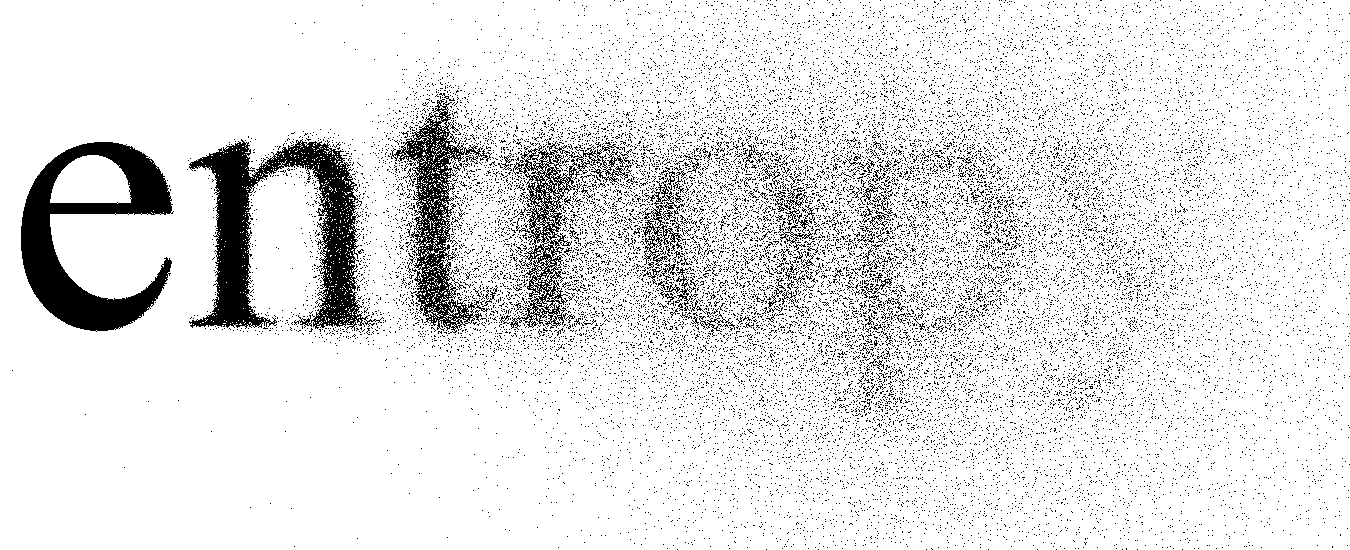
 Figure 1 shows one example of our images. Figure 2 shows another example.
Entropy Image
Figure 2: “Entropy” — from order to disorder.
Figure 1 shows one example of our images. Figure 2 shows another example.
Entropy Image
Figure 2: “Entropy” — from order to disorder.
The underlying strokes of the letters in Figure 2 are formed from five parallel black-white-black-white-black rows of dots. The position displacements and colors are allowed to become more random from left to right. The black and white colors make transitions to the same range of colors. We were unaware that this idea had been treated by Henry Segerman [8], though we have used different variations.
Night into Day
We have taken inspiration from several of M.C. Escher’s prints, most notably his three Metamorphosis prints. His transformation prints can be viewed at the official M.C. Escher web site [3]. One of his famous prints is Day and Night, which was part of our inspiration for our Figure 3, Night into Day below. However we reversed Escher’s light-to-dark order from left to right. Another important difference is that the left and right details of Escher’s print are mirror images except for the geese — the lines of white geese slant downward to the right and their tails also point downward, the opposite of the black geese. On the other hand the details in our image are placed randomly, the only exception being the symmetric positions of the sun and moon.
New Metamorphosis Patterns
In an early version of our image we only varied the background from black to white horizontally. But this produced a very noticeable transition in the middle. To remedy this, we also varied the background transition vertically.
Another challenge was the yucca-like plants in the bottom half of the image. Each individual plant is slightly (randomly) different. We start with a row of small plants at the midline, nominally at regular positions. Each lower row has plant heights which are a fixed multiple of the height above, i.e., a geometric progression. The downshift of each subsequent row is also increased by the same common geometric sequence ratio. This would produce a rather boring set of plants, so their locations are randomized a bit about the nominal ones. Finally the plants are allowed to overlap somewhat. There is no explicit horizon, but the small plants clustered near the midline provide one. Finally, note that the plants are all the same shade of gray half-way from black to white, making them stand out both on the left and the right.
The stars and birds are placed randomly with a uniform distribution in the upper half of the picture. The stars disappear against the white background on the right and the black birds disappear in the night on the left. The moon is somewhat unrealistic in that it should be an old or new moon if we could also see the sun, but it was left full for a bit of symmetry.
 Figure 3: “Night into Day”.
Teach a Fish to Swim
The pattern of Figure 4 starts on the left with a tiling of black fish alternating with white fish of the same shape. The outlines of the fish become more varied and wiggly as they progress from left to right. There is also a left-to-right transition of both black and white to random sea-like colors of greens, blues, and purples.
Dunham and Shier
 Figure 4: “Teach a Fish to Swim”.
Progressive Butterfly Patterns
Here we show two different butterfly transitions. In the first image, Figure 5, the colors change from black and white to shades of brown and yellow respectively, and interior details are added as we go from left to right.
 Figure 5: “Progressive Butterflies I”.
In the second image, Figure 6, the colors and interior details remain the same, but the outlines change from squares to butterflies as we progress from left to right.
New Metamorphosis Patterns
 Figure 6: “Progressive Butterflies II”.
Both patterns on the left are reminiscent of Escher’s Regular Division Drawing #12, though that was not our inspiration. On the other hand Escher’s drawing seems to have been inspired by an Arabic motif that he found in the Alhambra (see page 125 of Doris Schattschneider’s book M.C. Escher: Visions of Symmetry [7]).
Two Birds and Descent into Chaos
Figure 7 shows a transitions of two kinds of birds. Figure 8 shows transitioning curves. In contrast to the
 Figure 7: Two birds pattern.
 Figure 8: “Descent into Chaos.”
previous images, Figure 7 shows a radial transition from the regular tessellation by equilateral triangles at the center to birds of two different shapes and colors at the edges. This image is reminiscent of Escher’s
Dunham and Shier
lithograph Verbum, though that wasn’t our inspiration.
Figure 8 also differs from the previous images in that it progresses from order at the top to disorder at the bottom, instead of from left to right. There are two kinds of elements making transitions: the vertical curves which start out straight then become more curved, and the interspersed squares which start out as white and then become colored quadrilaterals.
Central transitions
The images in Figure 9 are related to Figure 7 in that the transitions are radial. These images use the same kind of transitions as in Figure 1, except that the transitions are radial instead of left-to-right. Escher’s woodcut Development I shows transitions that are similar to that of Figure 9 (b).
 (a)
Figure 9: (a) “In to Out”, and (b) “Out to In”.
(a)
Figure 9: (a) “In to Out”, and (b) “Out to In”.
 (b)
(b)
Soldiers and Elves
Figures 10 and 11 transform grim faces on the left to happy faces on the right. The elves start out as uncolored and but their faces acquire color and the hats become decorated as we progress from left to right.
 Figure 10: “Soldiers”.
New Metamorphosis Patterns
 Figure 11: “Elves”.
Waves of Emotion
The features of the faces in Figure 12 make changes controlled by a truncated Fourier series, passing through neutral, happy, sad, and ambivalent expressions. They are reminiscent of Chernoff faces [2].
 Figure 12: “Waves of Emotion”.
Dunham and Shier
Quantum Entanglement
The paths in Figure 13 start out straight and black on the left at “time” = 0, then there are small random changes to the curvature and color as time increases, producing jumbled, colored spaghetti on the right.
 Figure 13: “Quantum Entanglement Explained”.
Summary and Future Work
We have shown several different kinds of examples of computer generated “transition” or “metamorphosis” art. A few of our images were inspired by M.C. Escher. We also came up with some of images on our own, and later found out that they are related to other Escher patterns and images by other artists. We could certainly make new transition pictures ab initio and more pictures based on Escher’s other transition prints.
Acknowledgements
We would like to thank the reviewers for their useful comments.
References
[1] J. Arp. Untitled (Collage with Squares Arranged according to the Laws of Chance). MoMA, 1916-17. https://www.moma.org/collection/works/37013. (accessed Apr. 30, 2018). [2] Chernoff faces (Wikipedia). 2018. https://en.wikipedia.org/wiki/Chernoff_face (accessed Apr. 30, 2018). [3] M.C. Escher official web site transformation prints. 2018. http://www.mcescher.com/gallery/transformation-prints/ (accessed Apr. 30, 2018). [4] C. Kaplan. “Metamorphosis in Escher’s Art.” Bridges Conference Proceedings, Leeuwarden, the Netherlands, July 24-28, 2008, pp. 39-46. http://archive.bridgesmathart.org/2008/bridges2008-39.. [5] G. Nees. “Gravel Stones.” ACM SIGGRAPH Art Show Archives, 1986. http://digitalartarchive.siggraph.org/artwork/georg-nees-gravel-stones/. [6] Perlin noise (Wikipedia). 2018. https://en.wikipedia.org/wiki/Perlin_noise (accessed Apr. 30, 2018). [7] D. Schattschneider. M.C. Escher: Visions of Symmetry New Edition. Harry N. Abrams, 2004. [8] H. Segerman. “Autologlyphs.” 2009. http://www.segerman.org/autologlyphs/entropy.gif.