Parabolic Connections Linking History, Art, Acoustics, and Mathematics
Year: 2010 Authors: Gail Kaplan
Core claim
A parabola’s reflective property explains whispering galleries, sound mirrors, and related designs, making quadratics tangible across disciplines.
Topics
parabolic reflection, whispering galleries, sound mirrors, interdisciplinary teaching
Domains
quadratic functions, conic sections, reflection geometry, paraboloids, sculpture, acoustic installation, public art, architectural acoustics
Methods
geometric explanation, historical examples, visual diagrams, cross-disciplinary illustration
Media
sound mirrors, parabolic dishes, solar cooker, cathedral gallery
Paper text
The text below is the locally extracted OCR/Markdown version of the paper. Raw PDF files remain local and are not published here.
Bridges 2010: Mathematics, Music, Art, Architecture, Culture
Parabolic Connections Linking History, Art, Acoustics, and Mathematics
Gail Kaplan Department of Mathematics Towson University Towson, Maryland 21252, USA gkaplan@towson.edu
Abstract
This paper describes how the properties of a parabolic shape connect mathematics to unexpected fields of study including history, sculpture, and acoustics. The links to other subjects stimulate interest as students gain a more thorough understanding of quadratic functions.
Introduction
“It was a Sunday afternoon, wet and cheerless; and a duller spectacle this earth of ours has not to show than a rainy Sunday in London.” (Confessions of an English Opium Eater, by Thomas De Quincey, p.140)
Yet during De Quincey’s childhood visit to St. Paul’s Cathedral in London, the cathedral’s Whispering Gallery provides a bizarre experience as even the quietest of whispers transforms into peals of thunderous words. It is the remarkable properties of the mathematical shape of a parabola that explain this acoustic marvel. De Quincey’s nineteenth century visit foreshadows the future. During the early twentieth century, a network of whispering galleries were used throughout England by the air defense unit of the English military to provide advance knowledge of approaching enemy planes during war time.
Sound mirrors work by magnifying sound. To understand this phenomenon, we begin by examining the mathematics of reflection and then interpret these mathematical properties in terms of parabolic shapes.
| Consider a billiard ball traveling along the indicated path and hitting the edge of a pool table. | Path of Ball Pool Table |
|---|---|
| Construct the normal line, the line perpendicular to the table edge at the point where the ball hits the table | Normal Line Angle of Reflection |
| According to the law of reflection, to find the path of the ball after it hits the edge of the table, we reflect the original path over the normal line. The mathematical properties of reflection guarantee that the angle of incidence is equal to the angle of reflection under ideal conditions. | Angle of Reflection |
Kaplan
How does the reflective property work for curved surfaces?
| Definition: A parabola is the set of all points (x, y) in a given plane that are equidistant from a fixed point, the focus, and a fixed line, the directrix. | Focus Vertex Directrix |
|---|---|
| Parabolas have an intriguing, unexpected reflective property. Let’s consider how a ray of light or a sound wave is reflected. First, we sketch the line determined by the focus and the vertex. This is called the axis of symmetry for the parabola. | Focus Vertex |
| Next we sketch a ray parallel to this axis. Our next goal is to determine how this ray is reflected. | F |
| Recall that for a flat surface, the incoming ray is reflected over the normal line. To find the normal line for a parabolic curve, begin by drawing the tangent line to the curve at the given point. The normal line goes through the given point and is perpendicular to the tangent line. | Tangent Line F Normal Line |
| To find the reflection of the given vertical ray, reflect the ray over the normal line. | F |
| We repeat this process for several more rays parallel to the axis of symmetry. Notice what happens. All of the reflections pass through the focus! This special reflective property leads to fascinating applications. | |
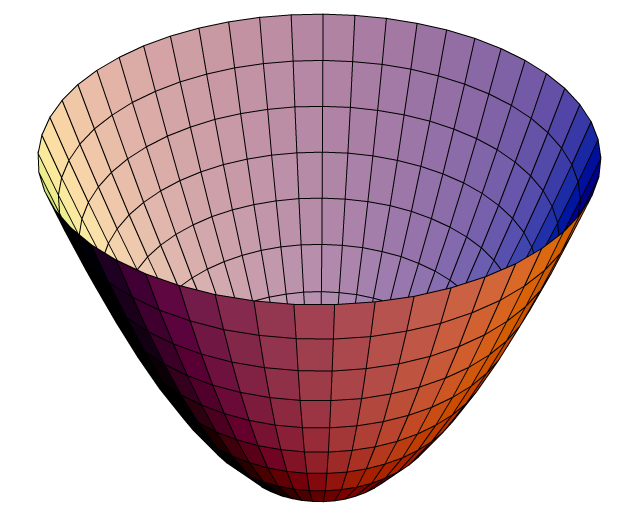
| Imagine that we revolve the parabola about its axis of symmetry. The three dimensional shape we obtain is called a paraboloid. The paraboloid is made up of infinitely many parabolas. Imagine that we take slices of this bowl type shape. Each slice is a parabola, illustrated by the curves in the diagram. Notice that every one of these parabolas has the same axis of symmetry and the same focus. Thus, all reflections will go through the same point. This property is the basis of fascinating connections to other disciplines. |
Parabolic Connections: Linking History, Art, Acoustics, and Mathematics
Connection to Whispering Galleries and War Time
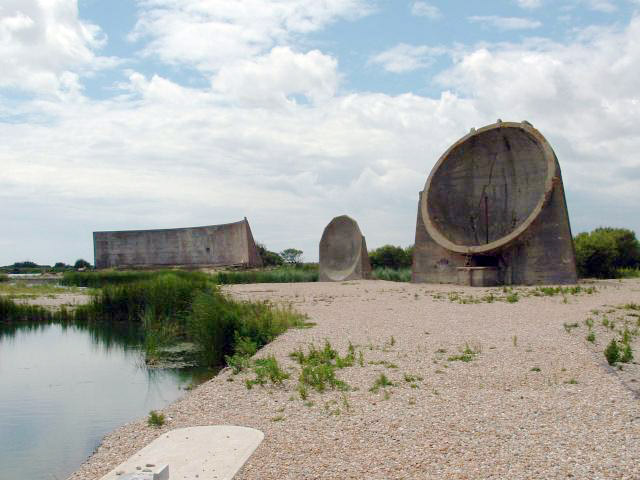
Imagine sound waves traveling parallel to the axis of symmetry of a paraboloid. All of the reflections of these waves not only pass through the focus, but do so at the same time, substantially magnifying the sound. This explains why the whispering gallery at St. Paul’s Cathedral transforms a gentle, hushed whisper into a deafening sound. The fun of transforming the quietest whisper possible to a loud noise so that a far away friend can hear is a delight! This playful property provided an early warning system for war time information. In the early twentieth century, the large cement sound mirror structures built along the coast of England were considered cutting edge technology and enabled advance knowledge of approaching enemy planes. Depending on the size of the sound mirror aircraft could be heard at a distance of about 20 miles as opposed to 6 miles for an unaided human ear, providing several extra minutes to prepare.
Three of the most well known examples of the sound mirror are on the southeastern coast of Kent, in the Dungeness peninsula. See Figure 1. The early warning devices were thought to have great potential prior to the invention of radar which provided far more advanced and in depth information. The bowls vary in shape, some parabolic and others hemispheric. It is interesting to note that the only sound mirror built outside of Great Britain is located in Il Widna, Maghtab, Malta. See Figure 2. Ironically, the translation of Il Widna is “listening ear.”
 Figure 1 Sound mirror at Dungeness
 Figure 2 Sound Mirror at Il Widna, Maghtab, Malta
The birth of radar took place on Tuesday, February 26, 1935. Radar instantly became the most advanced technology and the use of sound mirrors for defense died a quick death. Today, the sound mirror structures provide an interesting historical excursion.
Connection to Art and Music
Creative and artistic uses of sound mirrors are presented by Andreas Angelidakis on his website. Angelidakis displays a sound mirror orchestra and suggests that the artistic structures might be used in a park to capture the sounds of both people and nature. Imagine visiting a recreational area where the sounds of nature are magnified, making it possible to hear the soft, almost imperceptible sounds of trees and birds, sounds too soft for the human ear to hear clearly made possible with the aid of a sound mirror. See Figure 3. In Essex, England the Wat Tyler Sculpture Trail in Wat Tyler Country Park has sculptures called sonic marshmallows. See Figure 4. According to the park website, “The Sonic Marshmallows create a stunning acoustic experience: their shape focuses sound and allows people standing in front to hear each other’s whispers 60 metres over the pond that separates them.” Parabolic shapes are providing opportunities to enjoy nature, view unusual sculptures, and have fun!
Kaplan
 Figure 3 Sound Mirror Orchestra
 Figure 4 Sonic Marshmallow at Wat Tyler Country Park
Satellite dishes for TV, car headlights, and the reflective mirror behind light bulbs in overhead projectors are also based on the reflective property of this shape. The properties of a simple curve are essential for many of the items we use in our daily lives.
Connections to Daily Living
The same reflective property of the paraboloid works for light waves and is often the basis of solar cookers. Imagine a parabolic dish aimed toward the sun. As the rays hit the dish their reflections will all go through the focus, creating a hot spot. If food is placed in a pot at the focal point, the pot becomes a solar oven. See figure below.
 Figure 5 Solar Cooker
Conclusion
The parabola is an amazing shape linking mathematics, sculpture, acoustics, and history. It is an ideal tool to motivate students as they seek to explore and understand quadratics using an interdisciplinary approach.
References
Thomas De Quincey, Confessions of an English Opium Eater, Wordsworth Editions Limited, Hertfordshire, 1994 http://www.wattylercountrypark.org.uk/planning-your-visit/the-sonic-marshmallows/ http://upload.wikimedia.org/wikipedia/commons/4/40/Paraboloid_of_Revolution.png http://www.doramusic.com/soundmirrors.htm http://www.everythingiselectric.com/malta/il-widna-maghtab. http://upload.wikimedia.org/wikipedia/commons/c/cf/Denge_acoustic_mirrors_-March2005.jpg http://www.electricyouniverse.com/eye/index.php?level=picture&id=749 http://www.wattylercountrypark.org.uk/planning-your-visit/the-sonic-marshmallows/
378